Corporate Training (On-Site)
Become an accredited HSE Certified Paediatric First Aid Expert, delivered on-site or at our training venue, this course equips teams with the first aid/CPR and AED skills needed to meet workplace safety needs.
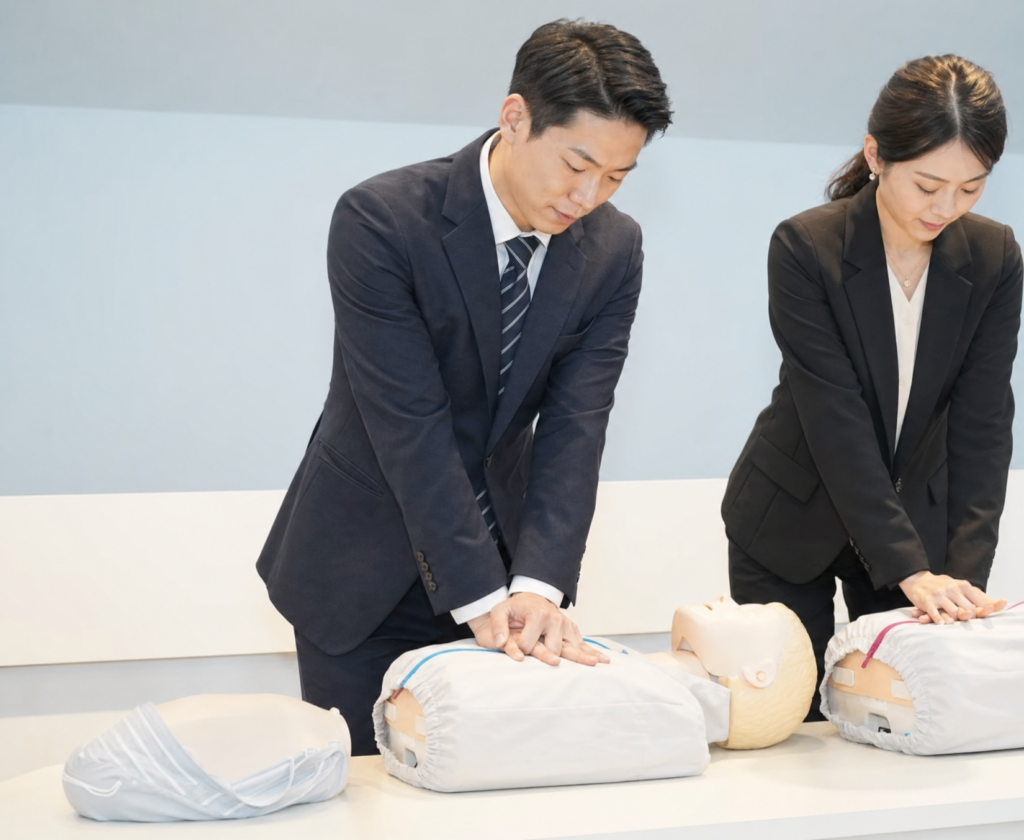
In a workplace, the person best placed to help in the first few minutes of an emergency usually isn’t a paramedic — it’s a colleague. Corporate First Aid, CPR and AED training is built for that reality: adults who are often the ones others are depending on, whether that’s a manager on the factory floor, a cabin crew member mid-flight, or a colleague on a tennis court.
These exact skills have saved real lives.
Christian Eriksen, Euro 2020 (12 June 2021): the Denmark midfielder went into cardiac arrest on the pitch during the opening match against Finland. Team medics gave immediate CPR and one defibrillator shock restarted his heart. He later received an implantable defibrillator and returned to professional football.
Damar Hamlin, NFL (2 January 2023): the Buffalo Bills player suffered a cardiac arrest (commotio cordis) after a chest impact during a game. On-field medical staff began CPR and used an AED within seconds. He recovered and returned to play — and the American Heart Association reported a nationwide spike in interest in hands-only CPR training in the weeks after.
Dr Christopher Wong, Singapore (19 May 2024): an A&E doctor collapsed from cardiac arrest while playing tennis in Bukit Timah. Three fellow doctors on court immediately began CPR; one had to run to a neighbouring condominium to borrow an AED because the venue didn’t have one on-site. He survived, and the responders were awarded SCDF Community Lifesaver Awards.
Singapore Airlines cabin crew, Barcelona (13 October 2025): a 71-year-old passenger became unresponsive and pulseless shortly before departure. Crew member Koh and colleagues performed CPR for around 20 minutes and delivered two AED shocks before his pulse returned. SIA later recognised the crew for their response.
Why this matters.
Singapore records roughly 1,800 out-of-hospital cardiac arrests a year, and the baseline survival rate is only around 2.8% — a number that rises sharply with immediate bystander CPR and AED use. SCDF’s myResponder app has alerted community first responders to over 3,800 cardiac arrest cases since launch, precisely because minutes, not ambulances, decide the outcome.
Which is why it becomes essential, that as an adult you equip yourself with the correct tools and knowledge to be present in a moment of crisis, during this course the following will be covered, depending on your pre-selected certification path:
Common Types of First Aid Emergencies
- Sudden cardiac arrest / collapse — can happen to anyone, at any fitness level, without warning
- Choking — during meals, work lunches, or client events
- Falls, slips and fractures — wet floors, stairs, ladders, uneven ground
- Cuts, lacerations and machinery injuries — particularly in industrial and F&B settings
- Burns and scalds — kitchens, pantries, hot equipment
- Electric shock — faulty equipment or wiring
- Heat exhaustion and heat stroke — a real risk for outdoor, warehouse and site-based teams in Singapore’s climate
- Allergic reactions / anaphylaxis — food-related, at office pantries or work events
- Stroke — recognising FAST signs (Face drooping, Arm weakness, Speech difficulty, Time to call for help) matters as much in an office as at home
CPR Techniques
- Check first: confirm the person is unresponsive and not breathing normally before starting
- Call and delegate: call 995 (or point directly at a colleague: “You, call 995. You, get the AED.”) — naming someone directly prevents everyone assuming someone else will act
- Hand position: heel of one hand on the centre of the chest, second hand on top, fingers interlocked
- Compression depth: about 5cm (2 inches)
- Compression rate: 100–120 compressions per minute
- Ratio: 30 compressions to 2 breaths; hands-only (compressions only, no breaths) is an accepted and effective option for an untrained or unwilling-to-give-breaths bystander
- Keep going until an AED is attached and ready to analyse, or professional help takes over
Choking Relief Techniques
- Recognise it: the person can’t speak, cough, or breathe — they may clutch their throat
- 5 back blows: use the heel of your hand to strike firmly between the shoulder blades
- 5 abdominal thrusts: stand behind the person, find their navel with two fingers, make a fist with your other hand and place the thumb side just above it, cover the fist with your other hand, and pull sharply inward and upward, 5 times
- Alternate 5 back blows and 5 abdominal thrusts until the object clears or the person becomes unresponsive
- If they become unresponsive: lower them to the ground and begin CPR, starting with compressions
- Exception: if the person is pregnant or too large to wrap your arms around, give chest thrusts instead of abdominal thrusts
Effective Use of an AED
- Check the scene is safe, then power on the AED — it will guide you with voice prompts from this point on
- Expose the chest and attach the pads exactly as shown in the pad diagram (skin should be dry; excess chest hair may need to be cleared for the pads to stick)
- Stand clear during rhythm analysis and shock delivery — no one should be touching the person
- Resume CPR immediately after a shock is delivered, following the AED’s prompts, until help arrives or the person shows signs of life
- Every minute that passes without defibrillation reduces survival chances by roughly 7–10% — which is why the AED closest to the emergency, and the confidence to use it, matters more than a perfect technique